<<
Back to Senior Design Course Outline
Measurement Error
Assume that you have an
expression that relates a design criterion to the individual components of your
system.
Eq. 1

As a simple example, z could
be the gain of an amplifier, and w, x and y could be the values of three
resistors in an operational amplifier circuit.
Alternatively, z could be the peak sustainable force of a bone plate,
and w, x, and y could be the thickness, width and elastic modulus of the plate.
What is the anticipated
standard deviation of
z, given the tolerances in w,
x and y? To answer this, we need a
definition for standard deviation. This
definition is given by:
Eq. 2

In other words, say that we
make N realizations of our
system. Then zi represents all of
the values of z (e.g. gain, if we are
building an amplifier) that we get in the N
prototypes, and  represents the average
value of z, which should be the
design value.
represents the average
value of z, which should be the
design value.
Example 1
You are designing an
amplifier whose gain, A, depends on
the values of two resistors and a capacitor.
Your design value for A is 10,
which corresponds to . You make five realizations, and their gains ( ) come out to be 10.2, 10.3, 9.9, 10.5, and 9.4. The variance in z,
  , is:
, is:
Eq. 3

which has a value of 0.1875.
Relating Error in z to Component Errors
We will refer to the error
in a parameter as  . Thus, for Example 1,
the error in z is
. Thus, for Example 1,
the error in z is  . Assume that you know
that z is related to the specific
parameters (w, x, y) through some
formula:
. Assume that you know
that z is related to the specific
parameters (w, x, y) through some
formula:
Eq. 4

(For example, in an
inverting amplifier, with  representing the gain
  of the amplifier and
depending on the feedback and input resistors
of the amplifier and
depending on the feedback and input resistors  and
and  , one can write
  in place of Equation
4.) We can expand Equation 4 in a
in place of Equation
4.) We can expand Equation 4 in a  :
:
Eq. 5

where  (in other words, it is
the value we would obtain for if all of the design
components are exactly correct). Now
substitute Equation 5 into Equation 2.
(in other words, it is
the value we would obtain for if all of the design
components are exactly correct). Now
substitute Equation 5 into Equation 2.
Eq. 6

The two terms,  , cancel so that the result is:
Eq. 7

There are two types of terms
in the summation. Three of them have the
form:

All of these are positive
valued because they are the products of squares. In other words, regardless of whether  is positive or
negative,
is positive or
negative,  must be positive. These terms will then add to the error in
z. There are also three “cross terms” of
the form:
must be positive. These terms will then add to the error in
z. There are also three “cross terms” of
the form:

On average, half of these
terms will be positive and half will be negative (i.e. half of the time  and
and  will have the same
sign and the other half of the time they will have opposite signs). Consequently, these terms will tend to cancel
one another out, so that these cross terms will disappear when the summation is
taken. As a result, Equation 7 can be
rewritten as:
will have the same
sign and the other half of the time they will have opposite signs). Consequently, these terms will tend to cancel
one another out, so that these cross terms will disappear when the summation is
taken. As a result, Equation 7 can be
rewritten as:
Eq. 8

The summation can be taken
individually over each term. Since the terms  , and
, and  are the same for each value of i, they can be brought out of the
summation to yield.
are the same for each value of i, they can be brought out of the
summation to yield.
Eq. 9

But standard deviation was
defined in Equation 2 as:

So Equation 8 becomes the
equation in the book.
Eq. 10

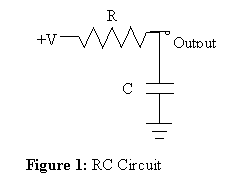 Example
For the circuit shown in
Figure 1, the expression for gain is:

The derivatives with respect
to R and C are:
 ,
, 
Given values for  and
and  (standard deviations
for the resistance and capacitance, which are the tolerances coded onto the
elements), the error in A can be calculated as:
(standard deviations
for the resistance and capacitance, which are the tolerances coded onto the
elements), the error in A can be calculated as:

From this, the expected
error in the gain, A, can be
calculated for any frequency  . The result is shown
in Figure 2, assuming a 10% error in both the resistor and the capacitor. Recall that this is an estimate of the error. The
true error may be somewhat larger or somewhat smaller than what is shown,
depending on what the actual values of the resistor and capacitor are. It should not be surprising that the error
goes to zero as frequency goes to zero because for an RC circuit, regardless of
the resistor and capacitor values, the gain is 1 at frequency zero. As frequency increases beyond the 3 db point
(in this case =100), the gain tends toward
. The result is shown
in Figure 2, assuming a 10% error in both the resistor and the capacitor. Recall that this is an estimate of the error. The
true error may be somewhat larger or somewhat smaller than what is shown,
depending on what the actual values of the resistor and capacitor are. It should not be surprising that the error
goes to zero as frequency goes to zero because for an RC circuit, regardless of
the resistor and capacitor values, the gain is 1 at frequency zero. As frequency increases beyond the 3 db point
(in this case =100), the gain tends toward  , which explains why 10% error in the components leads to 10%
error in A.
, which explains why 10% error in the components leads to 10%
error in A.
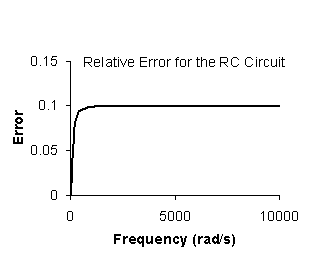
Figure 2:
Relative error for the RC circuit, assuming an error of 10% in both the
resistor and the capacitor. The
resistor value is 10 KW. The capacitor value is 1 mF.
Exercise 1: For a circuit
that consists of three resistors in series (R1, R2 and R3),
where R2 and R3 have 10% error and R1 has a 5%
error, what is the variance in the equivalent resistance of the circuit (Req = R1 + R2 + R3).
Exercise 2: The amount of transmitted light through a liquid
depends on the distance traveled by the light through the liquid and the
concentration of a coloring within the liquid according to:

Thus,
one can estimate the concentration of a substance (e.g. a tagged monoclonal
antibody) by inverting the above equation to obtain:
 .
.
Assume
that one is capable of measuring  ,
,  ,
,  , and
, and  to within 5%.
- Give the general
equation for error in
 as a function of
the errors in , , , and .
as a function of
the errors in , , , and . - With
 mW,
mW,  mW,
mW,  L/(mole-cm) and
  cm, what is the
concentration, and what is the expected error in the concentration?
cm, what is the
concentration, and what is the expected error in the concentration? - Which terms in the
error equation contribute most strongly to the error calculated in b.
above?
Steven A. Jones
BIEN 402, Biomedical Senior Design I